
What compels us in our striving to be the first at something? What if attaining the goal of first requires persistence through physical and mental obstacles?
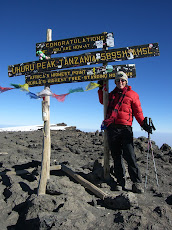
The first recorded person to summit Mt. Kilimanjaro was Yohani Kinyala Lauwo or Kinyala Johnnes Lauwo, a member of the Lauwo clan of the Chagga tribe. He was selected (forced really) by the Chagga chief to lead Hans Meyer and Austrian climber Ludwig Purtscheller to the top of the mountain. Meyer, a German geology professor, is credited as the first European to reach the summit in 1889 after two failed attempts.
Not much is written about Kinyala – besides the fact that he only had a few blankets to keep warm in the high altitude. Journals and dairies, however, report how Meyer and other Europeans before him suffered from hypothermia, altitude sickness, deteriorating morale and dwindling food supplies. A wall of ice ultimately blocked Meyer’s first attempt at summitting: he was forced to retreat because he didn’t have the proper equipment to scale the ice.
On his second try, Meyer and a traveling companion were captured and held prisoner by Chief Busuri. The two were released after a ransom was paid, but the chief kept all of their equipment and supplies. Another Chagga chieftain, Mandara, bragged of having met every European explorer in the region and extracting “gifts” from them in exchange for safe passage.
Records kept by European explorers cast doubt on the possibility that East African tribesmen could reach the summit of Mt. Kilimanjaro because they did not have the proper equipment. Sounds like they had plenty to me!
Meyer figured close to fifty other Europeans had taken a shot at climbing the mountain, and, if he wanted to be the first, he had better try again soon. He spent some time interviewing an American naturalist who had come the closest to gaining the summit. Meyer learned a lack of proper food supplies was the biggest obstacle, so he established a series of camps along the climbing route he would take, stocking the camps with food. He and Purtscheller were too exhausted to summit on their first attempt. But after a day of recuperating at a lower altitude, the two returned and crested the crater rim of Mt. Kilimanjaro.
Last Saturday night, we attended the Cirque Du Soleil-Kooza while it was in San Diego. Most of the performers did amazing things I had never seen before. A unicyclist twirled a woman above his head, tightrope walkers jumped over each other while thirty feet off the ground, two guys jumped rope on the outside of a large spinning metal contraption (who thinks up this stuff?). But the contortionists were the most incredible. I wonder, when they planned their act, did they say “let’s be the first to have one of us bend like a pretzel while the other does a one-armed handstand on the pretzel woman’s abs?” I know this is a tenuous connection to the drive to be first, but I still can’t get one of the contortionist’s poses out of my head. I didn’t close my eyes fast enough, and it lingers in my mind like fingernails on a chalkboard.
Maybe the drive to be first is intertwined (did you think of the pretzel woman? I did.) with the desire to make a mark on history. Kinyala got a new house built by the German government. Meyer has a bronze plaque on Mt. Kilimanjaro.
What do you think?
Information gathered from internet and “Kilimanjaro: A Complete Traveler’s Guide”
Friday, March 26, 2010

Friday, March 19, 2010
March 19, 2010
“Kilimanjaro is a snow covered mountain 19,110 feet high, and is said to be the highest mountain in Africa. Its western summit is called the Masai ‘Ngqje Ngai/The House of God. Close to the western summit there is the dried and frozen carcass of a leopard. No one has explained what the leopard was seeking at that altitude.” So begins Ernest Hemingway’s short story The Snows of Kilimanjaro.
A friend gave me a book about Mt. Kilimanjaro called “The Complete Trekker’s Guide.” It is full of useful information, but I must admit, I found the section on 19th –century European fascination with the mountain quite funny.
According to the book, and other sources, English armchair geographer William Desborough Cooley was considered an African expert because he had written major essays on the region’s geography although he had never been to East Africa. He was convinced Mt. Kilimanjaro was not high enough to sustain a perennial snowfield so near the equator.
When Swiss-German missionary Johannes Rebmann actually traveled to the region and saw the mountain in late 1848, he reported that he observed “something remarkably white on the top.” He said he first believed the white to be a cloud, but closer inspection confirmed it was snow.
Cooley and others ridiculed Rebmann’s findings, gaining support from a number of powerful public figures. I can just picture Cooley, his backside girded by his leather armchair, head hemmed by pipe smoke. “Snow on Mt. Kilimanjaro,” he would scoff. “Ridiculous. Figment of Mr. Rebmann’s imagination.”
David Livingston reported on other mountains in Africa topped by “glittering whiteness” which turned out to be “masses of white rock, somewhat like quartz.” Livingston’s reports further debunked Rebmann’s observations.
Another missionary confirmed Rebmann’s sightings of snow. Cooley insisted the second missionary was hallucinating.
Later explorers, some with scientific backgrounds, attempted to summit the mountain. One reached 14,000 feet only to be turned back by a snowstorm. Cooley dismissed the experience as a “traveler’s tale” about an “opportune fall of snow” all fabricated to support the two missionaries. Eventually, others lost faith in Cooley, and the Royal Geographic Society withdrew its support. But Cooley refused to recant, and went to his deathbed declaring snow an impossibility on Mt. Kilimanjaro.
This argument between “armchair academics” and scientists sounds strangely familiar…
As for the leopard mentioned by Hemingway, its corpse was discovered on the crater rim and photographed in 1926. The mummified animal disappeared from the mountain in the early 1930s. Its presence has yet to be explained.
A friend gave me a book about Mt. Kilimanjaro called “The Complete Trekker’s Guide.” It is full of useful information, but I must admit, I found the section on 19th –century European fascination with the mountain quite funny.
According to the book, and other sources, English armchair geographer William Desborough Cooley was considered an African expert because he had written major essays on the region’s geography although he had never been to East Africa. He was convinced Mt. Kilimanjaro was not high enough to sustain a perennial snowfield so near the equator.
When Swiss-German missionary Johannes Rebmann actually traveled to the region and saw the mountain in late 1848, he reported that he observed “something remarkably white on the top.” He said he first believed the white to be a cloud, but closer inspection confirmed it was snow.
Cooley and others ridiculed Rebmann’s findings, gaining support from a number of powerful public figures. I can just picture Cooley, his backside girded by his leather armchair, head hemmed by pipe smoke. “Snow on Mt. Kilimanjaro,” he would scoff. “Ridiculous. Figment of Mr. Rebmann’s imagination.”
David Livingston reported on other mountains in Africa topped by “glittering whiteness” which turned out to be “masses of white rock, somewhat like quartz.” Livingston’s reports further debunked Rebmann’s observations.
Another missionary confirmed Rebmann’s sightings of snow. Cooley insisted the second missionary was hallucinating.
Later explorers, some with scientific backgrounds, attempted to summit the mountain. One reached 14,000 feet only to be turned back by a snowstorm. Cooley dismissed the experience as a “traveler’s tale” about an “opportune fall of snow” all fabricated to support the two missionaries. Eventually, others lost faith in Cooley, and the Royal Geographic Society withdrew its support. But Cooley refused to recant, and went to his deathbed declaring snow an impossibility on Mt. Kilimanjaro.
This argument between “armchair academics” and scientists sounds strangely familiar…
As for the leopard mentioned by Hemingway, its corpse was discovered on the crater rim and photographed in 1926. The mummified animal disappeared from the mountain in the early 1930s. Its presence has yet to be explained.
Friday, March 12, 2010
March 12, 2010
Summitting Mt. Kilimanjaro will require not only good aerobic condition, but also a certain mind set. We have been told that on some days we will merely be putting one foot in front of the other and our determination to move forward will need to come to the forefront. Our desire to summit must be as strong as our bodies.
Running long distance requires the same effort, physical preparation as well as mental fortitude. When I ran half marathons, I knew how important thought persistence was, as the minute I would think "walking sounds great," my steps would slow.
But, today I am tired, and I'm wondering how to balance my desire to succeed with the wisdom of moderation.
My workout schedule last week: Saturday - hike in the snow at high altitude; Monday - a long walk; Tuesday - stairmaster, squats and weight lifting; Wednesday - a longer walk; Thursday - two long walks; Friday (today) - another long walk and weight lifting. Last Sunday I would normally have bicycled but I was out of town.
When my daughter and I went for our travel vaccinations, the doctor cautioned about the need to listen to our bodies when we hike Mt. Kilimanjaro. "The climb will be easier for you," he told my daughter, "because you are young. I'm counting on you to tell your mother to stop when it looks like she needs to." My daughter and I laughed.
But climbing at high altitude is serious, and could have deadly consequences. I need to commit not only to the notion of summitting, but also the belief that I did not fail if I physically cannot reach the top. A woman I know came within 400 feet of summitting Mt. Kilimanjaro and literally could not move another step. The guides gently turned her around and led her back to base camp.
When a friend and I walk together, we always have to touch something at our end point so we can turn around - a bench, a rock, a light post. I might not be able to touch the top of Mt. Kilimanjaro.
Now would be a good time for me to start listening to that voice of moderation, as my turning point on the hike might be sooner than I imagine.
Running long distance requires the same effort, physical preparation as well as mental fortitude. When I ran half marathons, I knew how important thought persistence was, as the minute I would think "walking sounds great," my steps would slow.
But, today I am tired, and I'm wondering how to balance my desire to succeed with the wisdom of moderation.
My workout schedule last week: Saturday - hike in the snow at high altitude; Monday - a long walk; Tuesday - stairmaster, squats and weight lifting; Wednesday - a longer walk; Thursday - two long walks; Friday (today) - another long walk and weight lifting. Last Sunday I would normally have bicycled but I was out of town.
When my daughter and I went for our travel vaccinations, the doctor cautioned about the need to listen to our bodies when we hike Mt. Kilimanjaro. "The climb will be easier for you," he told my daughter, "because you are young. I'm counting on you to tell your mother to stop when it looks like she needs to." My daughter and I laughed.
But climbing at high altitude is serious, and could have deadly consequences. I need to commit not only to the notion of summitting, but also the belief that I did not fail if I physically cannot reach the top. A woman I know came within 400 feet of summitting Mt. Kilimanjaro and literally could not move another step. The guides gently turned her around and led her back to base camp.
When a friend and I walk together, we always have to touch something at our end point so we can turn around - a bench, a rock, a light post. I might not be able to touch the top of Mt. Kilimanjaro.
Now would be a good time for me to start listening to that voice of moderation, as my turning point on the hike might be sooner than I imagine.
Thursday, March 4, 2010
March 4, 2010
Travelers will not be let into Tanzania unless they can show proof of having received a vaccination against Yellow Fever. Other shots we must be current on are: Hepatitis A, Typhoid, Tetanus, Diptheria, Measles and Polio.
Vaccinations (or anything that involves a needle going into my skin) top the list of my least favorite things to do. I always have to turn my head when my blood is drawn. I could never watch when my daughters got their vaccinations. In fact, when my first two were born, I opted for a natural birth just because I couldn't stomach the idea of an IV in the crook of my arm.
I wonder if my aversion to needles dates to my continued bouts with strep throat and tonsillitis when I was eight, and all those HUGE shots I had to get in my butt. Once I kicked the shot tray out of the nurse's hand. Penicillin sprayed everywhere. My mom was so embarrassed and I didn't get the toy she promised for good behavior.
Yesterday, my youngest daughter and I went to the local travel clinic for our shots. When I started SCUBA diving, I got the Hepatitis A series as we planned to travel to countries where the food and water were not always safe. So I was thankfully already set with that one. I opted for the oral Typhoid vaccine (love the option!). And, as with most my age, I suffered through the measles so no need to get vaccinated. I still had to get a Yellow Fever vaccination and an updated Tetanus. At least the Tetanus was in the same shot as the Diptheria vaccination.
We met the nurse in her office where we discussed our travel plans. I tried not to watch as she built the shots, shaking the miniature glass bottles of medicine, filling the needles, setting them carefully on her desk so they wouldn't roll off.
But I couldn't help myself.
It was like passing a freeway accident.
Then we had to wait for the doctor to sign for the shots. By the time he did so, the shots were looming, both metaphorically and physically.
Next, we walked to the examining room, the shots laid out on the all too familiar little plastic tray on top of a paper doily almost as if they were skewered shrimp.
I never believe the nurse when she says "You'll feel a little pinch now." But she was right about the first one - the DPT was a minor sting in my left arm. The Yellow Fever shot, however, burned. My daughter watched the needle go into my arm. Later, she said she wished she hadn't. She had never seen a needle that long before, and when she got her Yellow Fever shot, she was sure the needle nearly pierced all the way through her arm.
Now that I am all updated with my shots, I feel like I should work in a lot of traveling before they expire.
Vaccinations (or anything that involves a needle going into my skin) top the list of my least favorite things to do. I always have to turn my head when my blood is drawn. I could never watch when my daughters got their vaccinations. In fact, when my first two were born, I opted for a natural birth just because I couldn't stomach the idea of an IV in the crook of my arm.
I wonder if my aversion to needles dates to my continued bouts with strep throat and tonsillitis when I was eight, and all those HUGE shots I had to get in my butt. Once I kicked the shot tray out of the nurse's hand. Penicillin sprayed everywhere. My mom was so embarrassed and I didn't get the toy she promised for good behavior.
Yesterday, my youngest daughter and I went to the local travel clinic for our shots. When I started SCUBA diving, I got the Hepatitis A series as we planned to travel to countries where the food and water were not always safe. So I was thankfully already set with that one. I opted for the oral Typhoid vaccine (love the option!). And, as with most my age, I suffered through the measles so no need to get vaccinated. I still had to get a Yellow Fever vaccination and an updated Tetanus. At least the Tetanus was in the same shot as the Diptheria vaccination.
We met the nurse in her office where we discussed our travel plans. I tried not to watch as she built the shots, shaking the miniature glass bottles of medicine, filling the needles, setting them carefully on her desk so they wouldn't roll off.
But I couldn't help myself.
It was like passing a freeway accident.
Then we had to wait for the doctor to sign for the shots. By the time he did so, the shots were looming, both metaphorically and physically.
Next, we walked to the examining room, the shots laid out on the all too familiar little plastic tray on top of a paper doily almost as if they were skewered shrimp.
I never believe the nurse when she says "You'll feel a little pinch now." But she was right about the first one - the DPT was a minor sting in my left arm. The Yellow Fever shot, however, burned. My daughter watched the needle go into my arm. Later, she said she wished she hadn't. She had never seen a needle that long before, and when she got her Yellow Fever shot, she was sure the needle nearly pierced all the way through her arm.
Now that I am all updated with my shots, I feel like I should work in a lot of traveling before they expire.
Thursday, February 25, 2010
Feb. 25, 2010
A woman who climbed Mt. Kilimanjaro several years ago was kind enough to show me pictures of her hike. Near the front of her album is a picture of the Mt. Kilimanjaro summit above a layer of clouds. She said she took it from the window of an airplane. =O
Yes, I know the summit of Mt. Kilimanjaro is approximately 19,000 feet. But knowing that and actually visualizing it are two different things for me.
When one of my daughters was about to turn 17, I suggested we climb Half Dome for her birthday which was on August 17. Since the hike is about 17 miles round trip it sounded like a fun thing to do. All those seventeens. Who could resist?
I have been to Yosemite more times than I can count beginning when I was a child. I was familiar with Half Dome. I had gazed up at it often enough from the Yosemite Valley floor. It had been a long time since I viewed it from Glacier Point, however. My daughter's friend came with us on the hike. She had never been to Yosemite before. We set up camp near Glacier Point, then wound our way down to the viewpoint to give the friend an opportunity to see what we were proposing to climb.
When we pointed out Half Dome, sticking out like a hitchhiker's thumb, she was amazed that we actually hoped to get to the top of it.
I must admit - seeing the 8,800- foot dome from that angle took me aback as well. Maybe there was an easier side that we just couldn't see.
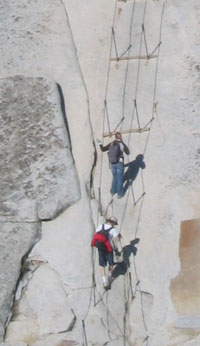
The next day when we got to the base of the dome, after passing the top of Nevada Falls and continuing through Little Yosemite Valley, I realized there wasn't an easier side. Hikers were pulling on leather work gloves and starting up the final 425 foot climb to the top. Without the steel cables to grab on either side of the three-foot wide "trail", it would be impossible to tackle the nearly 45 degree angle unless climbing equipment was used.
If I hadn't already hiked eight and a half miles to get to that point, I probably would not have continued. It was a scary experience - a lot more frightening to me than crossing the windows on the Mt. Whitney trail - and one that I don't plan on repeating.
As for Mt. Kilimanjaro, I might just close my eyes if the pilot of our airplane points out the famous summit before we land at the Tanzanian airport. Maybe I will be lucky enough to be on the side of the plane that doesn't have the view at all. =)
Yes, I know the summit of Mt. Kilimanjaro is approximately 19,000 feet. But knowing that and actually visualizing it are two different things for me.
When one of my daughters was about to turn 17, I suggested we climb Half Dome for her birthday which was on August 17. Since the hike is about 17 miles round trip it sounded like a fun thing to do. All those seventeens. Who could resist?
I have been to Yosemite more times than I can count beginning when I was a child. I was familiar with Half Dome. I had gazed up at it often enough from the Yosemite Valley floor. It had been a long time since I viewed it from Glacier Point, however. My daughter's friend came with us on the hike. She had never been to Yosemite before. We set up camp near Glacier Point, then wound our way down to the viewpoint to give the friend an opportunity to see what we were proposing to climb.
When we pointed out Half Dome, sticking out like a hitchhiker's thumb, she was amazed that we actually hoped to get to the top of it.
I must admit - seeing the 8,800- foot dome from that angle took me aback as well. Maybe there was an easier side that we just couldn't see.
The next day when we got to the base of the dome, after passing the top of Nevada Falls and continuing through Little Yosemite Valley, I realized there wasn't an easier side. Hikers were pulling on leather work gloves and starting up the final 425 foot climb to the top. Without the steel cables to grab on either side of the three-foot wide "trail", it would be impossible to tackle the nearly 45 degree angle unless climbing equipment was used.
If I hadn't already hiked eight and a half miles to get to that point, I probably would not have continued. It was a scary experience - a lot more frightening to me than crossing the windows on the Mt. Whitney trail - and one that I don't plan on repeating.
As for Mt. Kilimanjaro, I might just close my eyes if the pilot of our airplane points out the famous summit before we land at the Tanzanian airport. Maybe I will be lucky enough to be on the side of the plane that doesn't have the view at all. =)
Saturday, February 20, 2010
Feb. 20, 2010
Climbing Mt. Kilimanjaro will not be like any other wilderness experience I have had. On most backpacking trips, the desire is to get as far away from civilization as possible, to be "alone" in the untouched wilderness. I still laugh about the time I backpacked in the Desolation Wilderness in the Sierra Nevada Mountains. We had been hiking for a few days, and after the first day had not seen others on the trail. One day, we set up camp, and then decided to climb a nearby mountain. When we reached the top, South Lake Tahoe and it's many casinos were spread out just below us! I thought of all the dehydrated food, trail mix and stream caught trout we had been eating, our dirty, sweat soaked clothes, my balled up sweatshirt pillow and it was just too funny to see "civilization" right there on the other side of the mountain.
The lower section of the trail to Half Dome in Yosemite is well-traveled, populated with unprepared tourists wearing flip-flops and toting one water bottle for five. Stretches of the trail above Nevada Falls, however, are fairly hiker free, and the wilderness experience is possible.
Mt. Whitney is another popular trail, and hikers abound, but there are times when no others can be seen, the gurgling of clear water tumbling over stones can be heard, deer wander into a meadow.
Pictures I have seen of the Mt. Kilimanjaro trail show stunning scenery and varying micro climates: lush jungle foliage to scrub brush to rocks and glacier ice. We will be hiking the Machame Trail which I have been told is not as well-traversed as others. Still, our group of 13 hikers will have up to 37 support "staff." There will be three porters for each of us as well as guides for the group.
The woman organizing our trip (this will be her seventh Mt. Kilimanjaro climb) said she once passed a group of 50 hikers with a support staff in the hundreds. It is hard for me to imagine what that will look like on the trail.
A bonus in all the hikers: Mt. Kilimanjaro is a destination for international travelers. I'm excited about encountering people from other countries and hearing their stories, giving wilderness exploration a whole new meaning.
The lower section of the trail to Half Dome in Yosemite is well-traveled, populated with unprepared tourists wearing flip-flops and toting one water bottle for five. Stretches of the trail above Nevada Falls, however, are fairly hiker free, and the wilderness experience is possible.
Mt. Whitney is another popular trail, and hikers abound, but there are times when no others can be seen, the gurgling of clear water tumbling over stones can be heard, deer wander into a meadow.
Pictures I have seen of the Mt. Kilimanjaro trail show stunning scenery and varying micro climates: lush jungle foliage to scrub brush to rocks and glacier ice. We will be hiking the Machame Trail which I have been told is not as well-traversed as others. Still, our group of 13 hikers will have up to 37 support "staff." There will be three porters for each of us as well as guides for the group.
The woman organizing our trip (this will be her seventh Mt. Kilimanjaro climb) said she once passed a group of 50 hikers with a support staff in the hundreds. It is hard for me to imagine what that will look like on the trail.
A bonus in all the hikers: Mt. Kilimanjaro is a destination for international travelers. I'm excited about encountering people from other countries and hearing their stories, giving wilderness exploration a whole new meaning.
Thursday, February 11, 2010
Feb. 11, 2010
Public speaking is not a favorite of mine (kudos to all those who make a living at it). My heart always races in anticipation of standing up in front of an audience,knowing that a sea of faces will be watching me, that I will be bearing the pressure of their focus. Okay, well, if I'm honest, I could get into the idea of people thinking what I have to say is interesting. =) I wonder if that is a backlash of being a mother when you wonder if anybody is listening! But, I digress.
I went to the Ruby Room in Hillcrest with some writing friends last Friday to participate in an open mic reading sponsored by Dime Stories (www.dimestories.org) My heart was thumping like mad, and I wondered...does this count as aerobic training for Mt. Kilimanjaro? I posed the question to one of my writing friends and he said it would, if I got up to speak at least four times.(Each reading is limited to three minutes).
Since that wasn't going to happen, I figured the edge of my seat nervousness of waiting for the slip of paper with my name on it to be pulled from the bucket, the walking to the microphone, the actual reading and the breathing in my chair afterwards would have to do. I can feel the increased beating of my heart even now as I relive those moments.
I went to the Ruby Room in Hillcrest with some writing friends last Friday to participate in an open mic reading sponsored by Dime Stories (www.dimestories.org) My heart was thumping like mad, and I wondered...does this count as aerobic training for Mt. Kilimanjaro? I posed the question to one of my writing friends and he said it would, if I got up to speak at least four times.(Each reading is limited to three minutes).
Since that wasn't going to happen, I figured the edge of my seat nervousness of waiting for the slip of paper with my name on it to be pulled from the bucket, the walking to the microphone, the actual reading and the breathing in my chair afterwards would have to do. I can feel the increased beating of my heart even now as I relive those moments.
Subscribe to:
Posts (Atom)
A final view of Mt. Kilimanjaro

It's Official

At the Roof of Africa
Crater

Glaciers

Barafu Camp

Looking back at Karanga Valley Camp

Morning Send Off

Barranca Wall

Top of Barranca Wall

The Dining Tent

Trail to Lava Tower

Shira Camp

Machame Trail

Machame Gate

Half Dome cables
Towering Tree

this is a former house plant that I tired of, I didn't want to throw it out, so I dug a hole for it in the dog yard. It's thriving despite me.


