
Mt. Kilimanjaro is called "the roof of Africa" and is one of the largest volcanoes in the world. The mountain has three cones or vents - Shira, Mawenzi and Kibo - and was formed more than 750,000 years ago. Although now dormant, Kibo is the most recently formed cone and is thought to have been active as recently as a few hundred years ago. It is located, along with other large volcanoes in the Rift Valley - famous for the discovery of the remains of hominid ancestors including Lucy.
Movies and books about the prehistoric earth have fueled my imagination, and it's easy to picture volcanoes spewing lava and gases and the earth shifting in cataclysmic movements sparking fear in ancient beings.
Then, the earth moved under my feet on April 4, shaking the ocean front bluff where I was hiking, making me feel as if I were balancing on a tilting skateboard. A couple dashed past on the trail - they looked scared - but I'm not sure where they were planning on running to safety. The undulating stopped, and I learned later I had experienced a 7.2 earthquake centered in Calexico, Mexico, about 100 miles southeast of San Diego.
The other day, a volcano erupted in Iceland beneath the Eyjafjallajokull glacier. (I listened to a report on the eruption - hoping to learn how to pronounce the glacier's name, but the on-site reporter did everything he could to avoid saying it!) The volcanic ash cloud was so large it could be seen from space, and as it drifted over Northern Europe, air travel screeched to a halt stranding many. Volcanic ash apparently does not mix well with airplane engines or windshields. The television news report said the last time this particular volcano erupted - in 1821 - the eruption lasted for a year.
We no longer walk barefoot on the dirt every day or drive a cart on a rutted path or ride horses as our usual modes of transportation. We live in air conditioned/heated houses, drive in cars with anti-freeze and defrosters, sheltered from the most inclement weather. Many of us get our fresh fruit from pyramids carefully constructed at the local supermarket by produce workers. When I was a teen, I tried to milk a cow on my great-grandmother's South Dakota farm, and failed miserably. The thin, warm white liquid tasted funny to me.
And yet, the earth shifts and slips, a tidal wave surges, a volcano erupts and thousands are killed or injured or forced to stay put. We are reminded how fragile we still are despite our modern advances, how easily the rhythms of this active planet can disrupt and frighten us. How puny we really are.
Friday, April 16, 2010

Friday, April 9, 2010
April 9, 2010
Raising children is perhaps one of the most challenging undertakings. Nine months of gestation hardly seems enough time to prepare. After more than twenty five years of parenting, we are about to become empty nesters as our youngest heads off to college in the fall.
Those with multiple children know that each child is different, and not always ready to take on responsibility at the same age as the others did. As parents, we tire of diaper duty, and we wonder "is he or she ready to be toilet trained?"
Our child wants to walk to his or her friend's house to play, and we debate "is he or she equal to the challenge of navigating those blocks alone?" We warn them not to talk to strangers along the way and order them to call us the minute they arrive.
Some parents don't believe their child is ready to drive at 16. I know I will never forget the three times I slid into the passenger seat, buckled my seat belt and braced myself for each of my daughter's first whirl around the high school parking lot.
We are also called upon to gauge whether our offspring are equipped for first sleepovers, week-long camps and dating.
But what about more dangerous, uncommon challenges?
I recently read an Associated Press article about a thirteen year old who hopes to become the youngest climber to gain the 29,035 foot summit of Mt. Everest. According to the article, the teen hopes to eventually tackle the seven summits - the highest mountains on each of the seven continents. He was the youngest American at age ten to climb Mt. Kilimanjaro, and has successfully summitted three other mountains including Mt. McKinley.
My first, cynical reaction was "well, he will get into any college he wants," but then I wondered about the wisdom of his parents. Obviously, they know their child better than I do. But how much can a thirteen year old understand the risks of climbing a mountain that has killed many?
There is a reason the legal system defines those eighteen and older as adults, requiring hearings to determine whether younger teens should stand trial as adults. Recent studies have postulated that our brains are not fully developed until twenty five, and, as parents, we have been warned our children won't grow out of adolescence until their mid-to-late twenties.
Although I would never allow my children to climb Mt. Everest at such a young age, parents might be appalled to discover my youngest was SCUBA certified as a PADI diver when she was eleven. PADI will certify divers as young as ten.
SCUBA diving can be an extremely dangerous sport. Did my youngest always follow the rules? No. Did she understand the dangers of SCUBA diving? Probably not.
On our first dive trip, we got separated on a shallow night dive. Other young divers bounced off the sandy bottom and shot to the surface. A rapid ascent from a deep dive can be fatal.
I guess we all need to make the judgment call for our own children, and teach them to be responsible risk takers if there is such a thing. I know I don't want my daughters to be scared of life.
I hope the young climber survives Mt. Everest.
Those with multiple children know that each child is different, and not always ready to take on responsibility at the same age as the others did. As parents, we tire of diaper duty, and we wonder "is he or she ready to be toilet trained?"
Our child wants to walk to his or her friend's house to play, and we debate "is he or she equal to the challenge of navigating those blocks alone?" We warn them not to talk to strangers along the way and order them to call us the minute they arrive.
Some parents don't believe their child is ready to drive at 16. I know I will never forget the three times I slid into the passenger seat, buckled my seat belt and braced myself for each of my daughter's first whirl around the high school parking lot.
We are also called upon to gauge whether our offspring are equipped for first sleepovers, week-long camps and dating.
But what about more dangerous, uncommon challenges?
I recently read an Associated Press article about a thirteen year old who hopes to become the youngest climber to gain the 29,035 foot summit of Mt. Everest. According to the article, the teen hopes to eventually tackle the seven summits - the highest mountains on each of the seven continents. He was the youngest American at age ten to climb Mt. Kilimanjaro, and has successfully summitted three other mountains including Mt. McKinley.
My first, cynical reaction was "well, he will get into any college he wants," but then I wondered about the wisdom of his parents. Obviously, they know their child better than I do. But how much can a thirteen year old understand the risks of climbing a mountain that has killed many?
There is a reason the legal system defines those eighteen and older as adults, requiring hearings to determine whether younger teens should stand trial as adults. Recent studies have postulated that our brains are not fully developed until twenty five, and, as parents, we have been warned our children won't grow out of adolescence until their mid-to-late twenties.
Although I would never allow my children to climb Mt. Everest at such a young age, parents might be appalled to discover my youngest was SCUBA certified as a PADI diver when she was eleven. PADI will certify divers as young as ten.
SCUBA diving can be an extremely dangerous sport. Did my youngest always follow the rules? No. Did she understand the dangers of SCUBA diving? Probably not.
On our first dive trip, we got separated on a shallow night dive. Other young divers bounced off the sandy bottom and shot to the surface. A rapid ascent from a deep dive can be fatal.
I guess we all need to make the judgment call for our own children, and teach them to be responsible risk takers if there is such a thing. I know I don't want my daughters to be scared of life.
I hope the young climber survives Mt. Everest.
Friday, April 2, 2010
April 2, 2010
Trekking poles and a Tanzanian visa. Alliteration might be overused and a cliche, but I still like it!
So, I sent off for our Tanzanian visas last week. Many countries require a travel visa besides just a passport, and Tanzania is one of them. This process turned out to be a little more complicated than I expected.
First, passports valid for six months after travel are required and my husband needed to renew his passport which was set to expire in the middle of our trip. We also need our passports for a Memorial Day house building trip to Mexico, so I am biting my nails on this one.
We sent off the application, old passport, payment, required photos at the end of February. Finally, the new passport arrived in late March. Hooray!
Next, more passport size photos - two per person - were needed for the visas. This involved "encouraging" four busy people to get their pictures taken in a timely fashion.
Another complication: our youngest is 17 and a minor who requires a notarized letter from both parents to travel internationally. It doesn't matter that she will be 18 when we go to Tanzania.
At the post office, I was so happy to have all the required documents - four passports, eight photos, notarized letter, four applications, a check and a self-addressed stamped envelope. In my euphoria, however, I filled out the wrong box on the sending envelope and had to start over. BUT, the deed is done, and now my fingers are crossed (at least the ones I am not biting the nails on) that all will be returned soon with our official visas authorizing our Tanzanian travel.
Which brings me to our trekking poles.
Our Mt. Kilimanjaro hiking leader says we all must bring trekking poles. The first days of the climb will take us through a rain forest and the trail will be slippery with mud. Our final day might involve crossing snow slick gravel.
I used to never hike with trekking poles, but that was before I discovered how wonderful they are. Many with trekking poles passed us on the Mt. Whitney descent and I couldn't figure out why until I tried them myself on a backpacking trip.
I joke with my family that I would most likely still be on the top of Sawtooth pass in the Sequoia National Park mountains if I had not had trekking poles.
I've already shared one of my fears: steep downhills. The west side of Sawtooth Mountain is basically a gravel slide with no discernible trail. I was so happy to have my trusty trekking poles to help steady me as I slipped and slid down the loose rocks. They were certainly cheaper than the helicopter that would have been needed to airlift me from the mountain pass.
Trekking poles are also great for crossing streams. I don't like to rock hop. On Mt. Whitney, my daughter very lovingly guided me with her firm grip from wobbly rock to wobbly rock. Now, with my trekking poles, I can ford the streams on my own.
My husband and I checked out various trekking poles at a local store, and ended up ordering poles for ourselves online. They arrived last week.
Maybe I should uncross my fingers long enough to give them a try - or maybe our Tanzanian visas will show up soon.
So, I sent off for our Tanzanian visas last week. Many countries require a travel visa besides just a passport, and Tanzania is one of them. This process turned out to be a little more complicated than I expected.
First, passports valid for six months after travel are required and my husband needed to renew his passport which was set to expire in the middle of our trip. We also need our passports for a Memorial Day house building trip to Mexico, so I am biting my nails on this one.
We sent off the application, old passport, payment, required photos at the end of February. Finally, the new passport arrived in late March. Hooray!
Next, more passport size photos - two per person - were needed for the visas. This involved "encouraging" four busy people to get their pictures taken in a timely fashion.
Another complication: our youngest is 17 and a minor who requires a notarized letter from both parents to travel internationally. It doesn't matter that she will be 18 when we go to Tanzania.
At the post office, I was so happy to have all the required documents - four passports, eight photos, notarized letter, four applications, a check and a self-addressed stamped envelope. In my euphoria, however, I filled out the wrong box on the sending envelope and had to start over. BUT, the deed is done, and now my fingers are crossed (at least the ones I am not biting the nails on) that all will be returned soon with our official visas authorizing our Tanzanian travel.
Which brings me to our trekking poles.
Our Mt. Kilimanjaro hiking leader says we all must bring trekking poles. The first days of the climb will take us through a rain forest and the trail will be slippery with mud. Our final day might involve crossing snow slick gravel.
I used to never hike with trekking poles, but that was before I discovered how wonderful they are. Many with trekking poles passed us on the Mt. Whitney descent and I couldn't figure out why until I tried them myself on a backpacking trip.
I joke with my family that I would most likely still be on the top of Sawtooth pass in the Sequoia National Park mountains if I had not had trekking poles.
I've already shared one of my fears: steep downhills. The west side of Sawtooth Mountain is basically a gravel slide with no discernible trail. I was so happy to have my trusty trekking poles to help steady me as I slipped and slid down the loose rocks. They were certainly cheaper than the helicopter that would have been needed to airlift me from the mountain pass.
Trekking poles are also great for crossing streams. I don't like to rock hop. On Mt. Whitney, my daughter very lovingly guided me with her firm grip from wobbly rock to wobbly rock. Now, with my trekking poles, I can ford the streams on my own.
My husband and I checked out various trekking poles at a local store, and ended up ordering poles for ourselves online. They arrived last week.
Maybe I should uncross my fingers long enough to give them a try - or maybe our Tanzanian visas will show up soon.
Friday, March 26, 2010
March 26, 2010
What compels us in our striving to be the first at something? What if attaining the goal of first requires persistence through physical and mental obstacles?
The first recorded person to summit Mt. Kilimanjaro was Yohani Kinyala Lauwo or Kinyala Johnnes Lauwo, a member of the Lauwo clan of the Chagga tribe. He was selected (forced really) by the Chagga chief to lead Hans Meyer and Austrian climber Ludwig Purtscheller to the top of the mountain. Meyer, a German geology professor, is credited as the first European to reach the summit in 1889 after two failed attempts.
Not much is written about Kinyala – besides the fact that he only had a few blankets to keep warm in the high altitude. Journals and dairies, however, report how Meyer and other Europeans before him suffered from hypothermia, altitude sickness, deteriorating morale and dwindling food supplies. A wall of ice ultimately blocked Meyer’s first attempt at summitting: he was forced to retreat because he didn’t have the proper equipment to scale the ice.
On his second try, Meyer and a traveling companion were captured and held prisoner by Chief Busuri. The two were released after a ransom was paid, but the chief kept all of their equipment and supplies. Another Chagga chieftain, Mandara, bragged of having met every European explorer in the region and extracting “gifts” from them in exchange for safe passage.
Records kept by European explorers cast doubt on the possibility that East African tribesmen could reach the summit of Mt. Kilimanjaro because they did not have the proper equipment. Sounds like they had plenty to me!
Meyer figured close to fifty other Europeans had taken a shot at climbing the mountain, and, if he wanted to be the first, he had better try again soon. He spent some time interviewing an American naturalist who had come the closest to gaining the summit. Meyer learned a lack of proper food supplies was the biggest obstacle, so he established a series of camps along the climbing route he would take, stocking the camps with food. He and Purtscheller were too exhausted to summit on their first attempt. But after a day of recuperating at a lower altitude, the two returned and crested the crater rim of Mt. Kilimanjaro.
Last Saturday night, we attended the Cirque Du Soleil-Kooza while it was in San Diego. Most of the performers did amazing things I had never seen before. A unicyclist twirled a woman above his head, tightrope walkers jumped over each other while thirty feet off the ground, two guys jumped rope on the outside of a large spinning metal contraption (who thinks up this stuff?). But the contortionists were the most incredible. I wonder, when they planned their act, did they say “let’s be the first to have one of us bend like a pretzel while the other does a one-armed handstand on the pretzel woman’s abs?” I know this is a tenuous connection to the drive to be first, but I still can’t get one of the contortionist’s poses out of my head. I didn’t close my eyes fast enough, and it lingers in my mind like fingernails on a chalkboard.
Maybe the drive to be first is intertwined (did you think of the pretzel woman? I did.) with the desire to make a mark on history. Kinyala got a new house built by the German government. Meyer has a bronze plaque on Mt. Kilimanjaro.
What do you think?
Information gathered from internet and “Kilimanjaro: A Complete Traveler’s Guide”
The first recorded person to summit Mt. Kilimanjaro was Yohani Kinyala Lauwo or Kinyala Johnnes Lauwo, a member of the Lauwo clan of the Chagga tribe. He was selected (forced really) by the Chagga chief to lead Hans Meyer and Austrian climber Ludwig Purtscheller to the top of the mountain. Meyer, a German geology professor, is credited as the first European to reach the summit in 1889 after two failed attempts.
Not much is written about Kinyala – besides the fact that he only had a few blankets to keep warm in the high altitude. Journals and dairies, however, report how Meyer and other Europeans before him suffered from hypothermia, altitude sickness, deteriorating morale and dwindling food supplies. A wall of ice ultimately blocked Meyer’s first attempt at summitting: he was forced to retreat because he didn’t have the proper equipment to scale the ice.
On his second try, Meyer and a traveling companion were captured and held prisoner by Chief Busuri. The two were released after a ransom was paid, but the chief kept all of their equipment and supplies. Another Chagga chieftain, Mandara, bragged of having met every European explorer in the region and extracting “gifts” from them in exchange for safe passage.
Records kept by European explorers cast doubt on the possibility that East African tribesmen could reach the summit of Mt. Kilimanjaro because they did not have the proper equipment. Sounds like they had plenty to me!
Meyer figured close to fifty other Europeans had taken a shot at climbing the mountain, and, if he wanted to be the first, he had better try again soon. He spent some time interviewing an American naturalist who had come the closest to gaining the summit. Meyer learned a lack of proper food supplies was the biggest obstacle, so he established a series of camps along the climbing route he would take, stocking the camps with food. He and Purtscheller were too exhausted to summit on their first attempt. But after a day of recuperating at a lower altitude, the two returned and crested the crater rim of Mt. Kilimanjaro.
Last Saturday night, we attended the Cirque Du Soleil-Kooza while it was in San Diego. Most of the performers did amazing things I had never seen before. A unicyclist twirled a woman above his head, tightrope walkers jumped over each other while thirty feet off the ground, two guys jumped rope on the outside of a large spinning metal contraption (who thinks up this stuff?). But the contortionists were the most incredible. I wonder, when they planned their act, did they say “let’s be the first to have one of us bend like a pretzel while the other does a one-armed handstand on the pretzel woman’s abs?” I know this is a tenuous connection to the drive to be first, but I still can’t get one of the contortionist’s poses out of my head. I didn’t close my eyes fast enough, and it lingers in my mind like fingernails on a chalkboard.
Maybe the drive to be first is intertwined (did you think of the pretzel woman? I did.) with the desire to make a mark on history. Kinyala got a new house built by the German government. Meyer has a bronze plaque on Mt. Kilimanjaro.
What do you think?
Information gathered from internet and “Kilimanjaro: A Complete Traveler’s Guide”
Friday, March 19, 2010
March 19, 2010
“Kilimanjaro is a snow covered mountain 19,110 feet high, and is said to be the highest mountain in Africa. Its western summit is called the Masai ‘Ngqje Ngai/The House of God. Close to the western summit there is the dried and frozen carcass of a leopard. No one has explained what the leopard was seeking at that altitude.” So begins Ernest Hemingway’s short story The Snows of Kilimanjaro.
A friend gave me a book about Mt. Kilimanjaro called “The Complete Trekker’s Guide.” It is full of useful information, but I must admit, I found the section on 19th –century European fascination with the mountain quite funny.
According to the book, and other sources, English armchair geographer William Desborough Cooley was considered an African expert because he had written major essays on the region’s geography although he had never been to East Africa. He was convinced Mt. Kilimanjaro was not high enough to sustain a perennial snowfield so near the equator.
When Swiss-German missionary Johannes Rebmann actually traveled to the region and saw the mountain in late 1848, he reported that he observed “something remarkably white on the top.” He said he first believed the white to be a cloud, but closer inspection confirmed it was snow.
Cooley and others ridiculed Rebmann’s findings, gaining support from a number of powerful public figures. I can just picture Cooley, his backside girded by his leather armchair, head hemmed by pipe smoke. “Snow on Mt. Kilimanjaro,” he would scoff. “Ridiculous. Figment of Mr. Rebmann’s imagination.”
David Livingston reported on other mountains in Africa topped by “glittering whiteness” which turned out to be “masses of white rock, somewhat like quartz.” Livingston’s reports further debunked Rebmann’s observations.
Another missionary confirmed Rebmann’s sightings of snow. Cooley insisted the second missionary was hallucinating.
Later explorers, some with scientific backgrounds, attempted to summit the mountain. One reached 14,000 feet only to be turned back by a snowstorm. Cooley dismissed the experience as a “traveler’s tale” about an “opportune fall of snow” all fabricated to support the two missionaries. Eventually, others lost faith in Cooley, and the Royal Geographic Society withdrew its support. But Cooley refused to recant, and went to his deathbed declaring snow an impossibility on Mt. Kilimanjaro.
This argument between “armchair academics” and scientists sounds strangely familiar…
As for the leopard mentioned by Hemingway, its corpse was discovered on the crater rim and photographed in 1926. The mummified animal disappeared from the mountain in the early 1930s. Its presence has yet to be explained.
A friend gave me a book about Mt. Kilimanjaro called “The Complete Trekker’s Guide.” It is full of useful information, but I must admit, I found the section on 19th –century European fascination with the mountain quite funny.
According to the book, and other sources, English armchair geographer William Desborough Cooley was considered an African expert because he had written major essays on the region’s geography although he had never been to East Africa. He was convinced Mt. Kilimanjaro was not high enough to sustain a perennial snowfield so near the equator.
When Swiss-German missionary Johannes Rebmann actually traveled to the region and saw the mountain in late 1848, he reported that he observed “something remarkably white on the top.” He said he first believed the white to be a cloud, but closer inspection confirmed it was snow.
Cooley and others ridiculed Rebmann’s findings, gaining support from a number of powerful public figures. I can just picture Cooley, his backside girded by his leather armchair, head hemmed by pipe smoke. “Snow on Mt. Kilimanjaro,” he would scoff. “Ridiculous. Figment of Mr. Rebmann’s imagination.”
David Livingston reported on other mountains in Africa topped by “glittering whiteness” which turned out to be “masses of white rock, somewhat like quartz.” Livingston’s reports further debunked Rebmann’s observations.
Another missionary confirmed Rebmann’s sightings of snow. Cooley insisted the second missionary was hallucinating.
Later explorers, some with scientific backgrounds, attempted to summit the mountain. One reached 14,000 feet only to be turned back by a snowstorm. Cooley dismissed the experience as a “traveler’s tale” about an “opportune fall of snow” all fabricated to support the two missionaries. Eventually, others lost faith in Cooley, and the Royal Geographic Society withdrew its support. But Cooley refused to recant, and went to his deathbed declaring snow an impossibility on Mt. Kilimanjaro.
This argument between “armchair academics” and scientists sounds strangely familiar…
As for the leopard mentioned by Hemingway, its corpse was discovered on the crater rim and photographed in 1926. The mummified animal disappeared from the mountain in the early 1930s. Its presence has yet to be explained.
Friday, March 12, 2010
March 12, 2010
Summitting Mt. Kilimanjaro will require not only good aerobic condition, but also a certain mind set. We have been told that on some days we will merely be putting one foot in front of the other and our determination to move forward will need to come to the forefront. Our desire to summit must be as strong as our bodies.
Running long distance requires the same effort, physical preparation as well as mental fortitude. When I ran half marathons, I knew how important thought persistence was, as the minute I would think "walking sounds great," my steps would slow.
But, today I am tired, and I'm wondering how to balance my desire to succeed with the wisdom of moderation.
My workout schedule last week: Saturday - hike in the snow at high altitude; Monday - a long walk; Tuesday - stairmaster, squats and weight lifting; Wednesday - a longer walk; Thursday - two long walks; Friday (today) - another long walk and weight lifting. Last Sunday I would normally have bicycled but I was out of town.
When my daughter and I went for our travel vaccinations, the doctor cautioned about the need to listen to our bodies when we hike Mt. Kilimanjaro. "The climb will be easier for you," he told my daughter, "because you are young. I'm counting on you to tell your mother to stop when it looks like she needs to." My daughter and I laughed.
But climbing at high altitude is serious, and could have deadly consequences. I need to commit not only to the notion of summitting, but also the belief that I did not fail if I physically cannot reach the top. A woman I know came within 400 feet of summitting Mt. Kilimanjaro and literally could not move another step. The guides gently turned her around and led her back to base camp.
When a friend and I walk together, we always have to touch something at our end point so we can turn around - a bench, a rock, a light post. I might not be able to touch the top of Mt. Kilimanjaro.
Now would be a good time for me to start listening to that voice of moderation, as my turning point on the hike might be sooner than I imagine.
Running long distance requires the same effort, physical preparation as well as mental fortitude. When I ran half marathons, I knew how important thought persistence was, as the minute I would think "walking sounds great," my steps would slow.
But, today I am tired, and I'm wondering how to balance my desire to succeed with the wisdom of moderation.
My workout schedule last week: Saturday - hike in the snow at high altitude; Monday - a long walk; Tuesday - stairmaster, squats and weight lifting; Wednesday - a longer walk; Thursday - two long walks; Friday (today) - another long walk and weight lifting. Last Sunday I would normally have bicycled but I was out of town.
When my daughter and I went for our travel vaccinations, the doctor cautioned about the need to listen to our bodies when we hike Mt. Kilimanjaro. "The climb will be easier for you," he told my daughter, "because you are young. I'm counting on you to tell your mother to stop when it looks like she needs to." My daughter and I laughed.
But climbing at high altitude is serious, and could have deadly consequences. I need to commit not only to the notion of summitting, but also the belief that I did not fail if I physically cannot reach the top. A woman I know came within 400 feet of summitting Mt. Kilimanjaro and literally could not move another step. The guides gently turned her around and led her back to base camp.
When a friend and I walk together, we always have to touch something at our end point so we can turn around - a bench, a rock, a light post. I might not be able to touch the top of Mt. Kilimanjaro.
Now would be a good time for me to start listening to that voice of moderation, as my turning point on the hike might be sooner than I imagine.
Thursday, March 4, 2010
March 4, 2010
Travelers will not be let into Tanzania unless they can show proof of having received a vaccination against Yellow Fever. Other shots we must be current on are: Hepatitis A, Typhoid, Tetanus, Diptheria, Measles and Polio.
Vaccinations (or anything that involves a needle going into my skin) top the list of my least favorite things to do. I always have to turn my head when my blood is drawn. I could never watch when my daughters got their vaccinations. In fact, when my first two were born, I opted for a natural birth just because I couldn't stomach the idea of an IV in the crook of my arm.
I wonder if my aversion to needles dates to my continued bouts with strep throat and tonsillitis when I was eight, and all those HUGE shots I had to get in my butt. Once I kicked the shot tray out of the nurse's hand. Penicillin sprayed everywhere. My mom was so embarrassed and I didn't get the toy she promised for good behavior.
Yesterday, my youngest daughter and I went to the local travel clinic for our shots. When I started SCUBA diving, I got the Hepatitis A series as we planned to travel to countries where the food and water were not always safe. So I was thankfully already set with that one. I opted for the oral Typhoid vaccine (love the option!). And, as with most my age, I suffered through the measles so no need to get vaccinated. I still had to get a Yellow Fever vaccination and an updated Tetanus. At least the Tetanus was in the same shot as the Diptheria vaccination.
We met the nurse in her office where we discussed our travel plans. I tried not to watch as she built the shots, shaking the miniature glass bottles of medicine, filling the needles, setting them carefully on her desk so they wouldn't roll off.
But I couldn't help myself.
It was like passing a freeway accident.
Then we had to wait for the doctor to sign for the shots. By the time he did so, the shots were looming, both metaphorically and physically.
Next, we walked to the examining room, the shots laid out on the all too familiar little plastic tray on top of a paper doily almost as if they were skewered shrimp.
I never believe the nurse when she says "You'll feel a little pinch now." But she was right about the first one - the DPT was a minor sting in my left arm. The Yellow Fever shot, however, burned. My daughter watched the needle go into my arm. Later, she said she wished she hadn't. She had never seen a needle that long before, and when she got her Yellow Fever shot, she was sure the needle nearly pierced all the way through her arm.
Now that I am all updated with my shots, I feel like I should work in a lot of traveling before they expire.
Vaccinations (or anything that involves a needle going into my skin) top the list of my least favorite things to do. I always have to turn my head when my blood is drawn. I could never watch when my daughters got their vaccinations. In fact, when my first two were born, I opted for a natural birth just because I couldn't stomach the idea of an IV in the crook of my arm.
I wonder if my aversion to needles dates to my continued bouts with strep throat and tonsillitis when I was eight, and all those HUGE shots I had to get in my butt. Once I kicked the shot tray out of the nurse's hand. Penicillin sprayed everywhere. My mom was so embarrassed and I didn't get the toy she promised for good behavior.
Yesterday, my youngest daughter and I went to the local travel clinic for our shots. When I started SCUBA diving, I got the Hepatitis A series as we planned to travel to countries where the food and water were not always safe. So I was thankfully already set with that one. I opted for the oral Typhoid vaccine (love the option!). And, as with most my age, I suffered through the measles so no need to get vaccinated. I still had to get a Yellow Fever vaccination and an updated Tetanus. At least the Tetanus was in the same shot as the Diptheria vaccination.
We met the nurse in her office where we discussed our travel plans. I tried not to watch as she built the shots, shaking the miniature glass bottles of medicine, filling the needles, setting them carefully on her desk so they wouldn't roll off.
But I couldn't help myself.
It was like passing a freeway accident.
Then we had to wait for the doctor to sign for the shots. By the time he did so, the shots were looming, both metaphorically and physically.
Next, we walked to the examining room, the shots laid out on the all too familiar little plastic tray on top of a paper doily almost as if they were skewered shrimp.
I never believe the nurse when she says "You'll feel a little pinch now." But she was right about the first one - the DPT was a minor sting in my left arm. The Yellow Fever shot, however, burned. My daughter watched the needle go into my arm. Later, she said she wished she hadn't. She had never seen a needle that long before, and when she got her Yellow Fever shot, she was sure the needle nearly pierced all the way through her arm.
Now that I am all updated with my shots, I feel like I should work in a lot of traveling before they expire.
Subscribe to:
Posts (Atom)
A final view of Mt. Kilimanjaro

It's Official

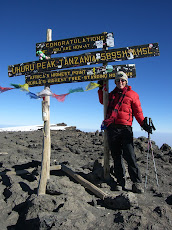
At the Roof of Africa
Crater

Glaciers

Barafu Camp

Looking back at Karanga Valley Camp

Morning Send Off

Barranca Wall

Top of Barranca Wall

The Dining Tent

Trail to Lava Tower

Shira Camp

Machame Trail

Machame Gate

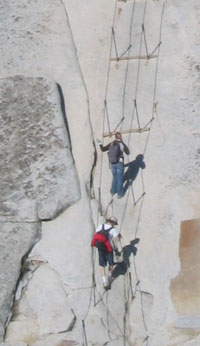
Half Dome cables
Towering Tree

this is a former house plant that I tired of, I didn't want to throw it out, so I dug a hole for it in the dog yard. It's thriving despite me.


